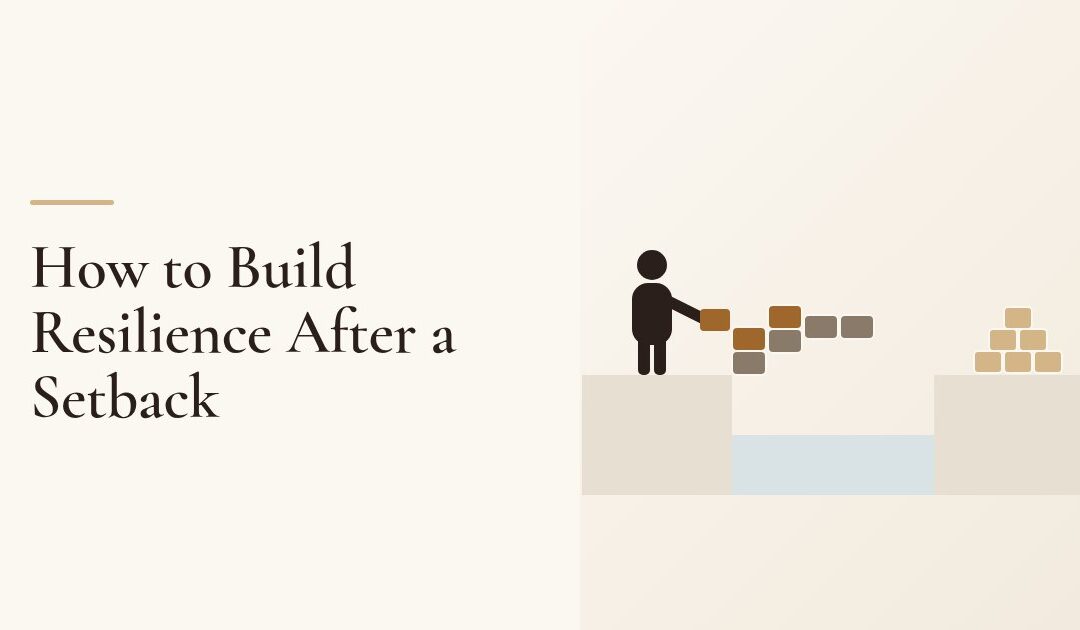
How to build resilience after a setback comes down to four moves, done in order: stabilize your basic routine, separate what actually happened from the story you are telling about it, pull out the one or two transferable lessons, and then rebuild capacity in deliberately small increments. Resilience is not a personality type you either have or lack. It is a sequence you can run, and it works better when you run it on purpose rather than waiting to feel normal again.
This is educational material about skills and routines, not treatment advice. If a setback has left you struggling in ways that go beyond disappointment, the right next step is a qualified professional, not a framework.
Why "just stay positive" fails
Setbacks are not only emotional events. They also remove structure. A lost role takes your calendar with it. A failed launch takes your sense of direction. A relationship ending takes your daily rhythm. The feeling of being unable to cope is often a structural problem wearing an emotional costume.
That is why advice to think positively lands so poorly. It asks you to change the interpretation of a situation while leaving the practical hole untouched. Resilience work goes the other way: restore enough structure that your judgment comes back online, then work on interpretation.
Step 1: Stabilize before you strategize
For the first stretch after a real setback, your only job is to keep the floor under you. Ambitious plans made in the first week usually get abandoned in the third.
Protect four things, in this order:
- Sleep timing. Not perfect sleep, just consistent bed and wake times. Irregular timing distorts everything you think about your situation.
- Movement. A daily walk counts. The purpose is regulation and a sense of forward motion, not fitness.
- One anchor obligation. Keep one commitment that puts you somewhere at a fixed time each week. A class, a volunteer shift, a standing meet-up. Structure you cannot renegotiate alone is worth more than structure you can.
- Contact with two people. Pick two specific people and actually talk to them on a schedule. Withdrawal is the default after a setback, and it is the single most expensive habit in the recovery.
Do not make large decisions in this phase. The instinct to immediately pivot, relocate, or reinvent is usually the setback talking.
Step 2: Separate the event from the story
Once the floor is steady, write two columns. The left column holds only verifiable facts. The right column holds every interpretation you are carrying.
A worked example. Facts: the contract was not renewed; two of six projects missed deadlines; the decision was communicated in March. Story: I am not good at this; everyone saw it coming; I am too old to start over; I ruined it.
Look at the two columns together and notice how much of the weight is in the right one. That is not a trick to make you feel better. It is an accuracy exercise, and accuracy is the raw material for a good next decision.
Then interrogate the story column with three questions:
- What is the evidence for this, stated as something a neutral observer could check?
- What is the evidence against it that I have been skipping over?
- If a capable friend described this exact situation to me, what would I tell them?
Most story-column items shrink considerably under those three questions. The ones that survive are usually real and specific, like a genuine skill gap. Those belong in step three.
Step 3: How to build resilience after a setback by extracting the lesson
There is a narrow window where a setback is still vivid enough to teach you something and far enough away that you can look at it. Use it.
Write a short, unsentimental review. Four prompts are enough:
- What was inside my control? Be honest but bounded. Not everything was yours.
- What was outside it? Timing, markets, other people's decisions, luck. Naming these is not excuse-making; it is calibration.
- What signal did I see and ignore? Almost every setback has one. Finding it is more valuable than any amount of reassurance.
- What is the one change I would make if this situation repeated? One. A review producing eleven changes produces zero.
Then stop. Reviewing the same event repeatedly past this point stops being learning and becomes rumination. Set a boundary: you have reviewed it, you have the lesson written down, and the file is closed. If it comes back, reread the page rather than reopening the whole investigation.
Step 4: Rebuild capacity in small, visible increments
Confidence does not return because you decided to feel confident. It returns because you accumulate recent evidence of competence. So manufacture evidence deliberately.
- Pick a project you can finish in two weeks. Small, concrete, and entirely within your control. Finishing matters more than scale.
- Make it visible. Something you can show, send, or point at. Private wins count for less in the early rebuild.
- Do a second one. Two completions establish a pattern; one is an anecdote.
- Then raise the stakes one level. Not five levels. One. The goal is an unbroken chain of recent completions, not a dramatic comeback.
- Keep a short record. A running list of things finished since the setback. On low days, this list is far more persuasive than any pep talk, because it is just facts.
This is also where you rebuild the specific skill the review identified. Pair the capability gap with the small projects, so each completion closes a bit of it.
A simple resilience checklist
Use this weekly during a rebuild:
- Sleep and wake times held within about an hour of target
- Moved my body most days
- Kept the anchor obligation
- Actual conversation with both named people
- No new decisions made from panic
- Facts column reread, story column not expanded
- One small project moving or finished
- Completion list updated
Eight lines. If six are ticked, you are recovering, regardless of how the week felt.
What resilient people do differently
Three habits show up consistently in people who move through setbacks well.
They shorten the gap between the event and the review. Not instantly, but within weeks rather than years. The longer the event sits unexamined, the more the story column grows unchallenged.
They keep their identity wider than any one role. When your sense of self rests on a single pillar, losing that pillar is catastrophic by definition. Keeping two or three live domains, such as work, a craft, and a community, means a hit to one is painful rather than total.
They treat recovery as a skill they will need again. A setback is not an interruption of ordinary life; it is a feature of it. People who assume more are coming build the routine once and reuse it, which is why they look unflappable the third time around.
The short version
Stabilize the structure first, because your judgment depends on it. Split the facts from the story, because the story is carrying most of the weight. Take one lesson and close the file. Then rebuild with small finished things until recent evidence outweighs the setback.
Resilience is the sequence, not the feeling. Run the sequence and the feeling catches up.
For a deeper walk through the stabilize-review-rebuild sequence with worksheets you can reuse, start with the Free Personal Development eBook Bundle — 4 Books on this site.