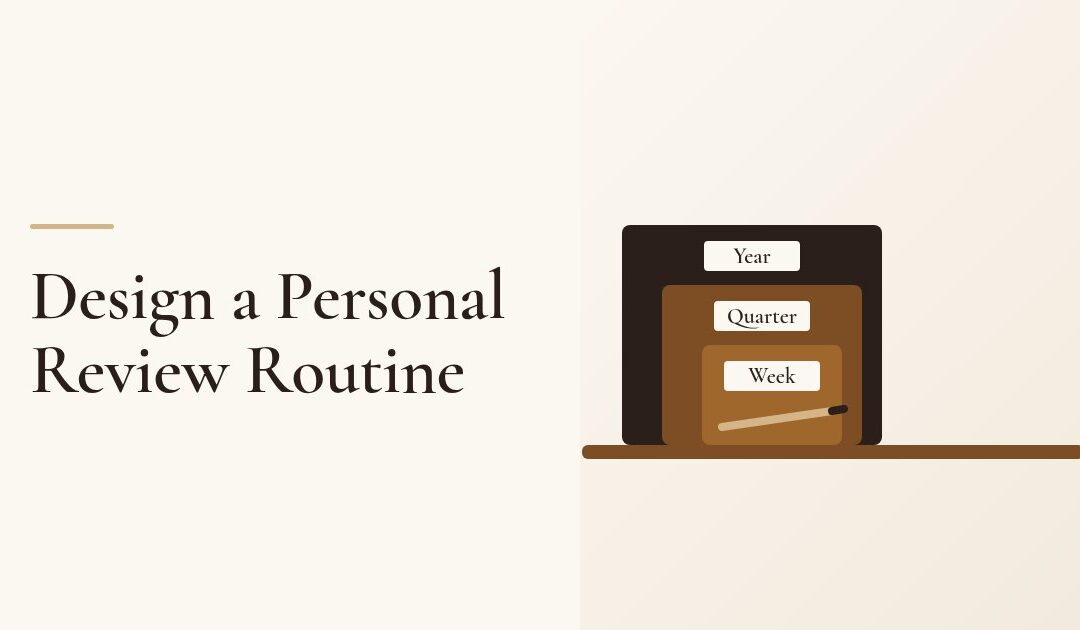
A personal review routine works when it has three layers running at different speeds: a short weekly review that handles course corrections, a longer quarterly review that reconsiders direction, and a brief annual review that checks whether the direction itself is still the one you want. Most people attempt only the annual one, discover it is too late to change anything, and conclude that reviews do not work.
The layering matters because different questions belong at different intervals. Asking "is this the right career" every Sunday produces anxiety, not insight. Asking "did I do the things I said I would" once a year produces nothing useful at all.
Why reviews fail
Four reasons, consistently.
Too long. A ninety-minute weekly ritual gets done twice. Keep the weekly to twenty minutes and it survives.
No decision at the end. A review that produces only observations is journaling. Useful, but it will not change anything. Every review needs to end with a named change and a next action.
Wrong question at the wrong interval. Strategic questions in a weekly slot create churn. Tactical questions in an annual slot create a list of forgotten details.
No fixed slot. "Sunday evening sometime" becomes never by week four. Attach it to an existing fixed event and put it on the calendar.
The weekly review: twenty minutes
This layer is about traction. You are checking the gap between intention and behavior while it is small enough to close.
Run it at the same point every week. Six questions:
- What did I actually finish this week? Completions only, not activity. Write them down even when the list is short, because this is the record that later makes progress visible.
- What did I say I would do and not do? No justification, just the facts. The pattern across weeks is the signal.
- Where did my time actually go? Compare against where you intended it to go. You are looking for the one recurring leak.
- What is the single most important thing for next week? One item. If you name three, you have named none.
- What is the first concrete action on it, and when? Specific enough to start without thinking. A time slot, not an intention.
- What one thing am I removing or saying no to? A review that only adds will eventually collapse under its own weight.
Twenty minutes, same time, same place. The point is not profundity. The point is the honest comparison between what you said and what happened.
The quarterly review: ninety minutes
Thirteen weeks is long enough for a direction to prove itself and short enough that changing course is still cheap. This is the most valuable layer and the one most people skip.
Block ninety minutes somewhere away from your usual desk. Work through four sections.
Look back
- Read your last thirteen weekly reviews. This is why you keep them.
- What did I complete this quarter that mattered?
- What did I start and abandon? Why, honestly?
- Which recurring item appeared in the weekly reviews over and over without ever moving? That item is either genuinely important and blocked, or not actually important. Decide which.
- What capability do I have now that I did not have in week one?
Look at the shape of your life
Score each of these from one to ten, and more importantly write one sentence of evidence for each score:
- Work and craft
- Health and energy
- Money and security
- Relationships
- Learning and growth
- Rest and play
The scores are not the output. The evidence sentences are. A seven you cannot justify is not a seven; it is a habit of saying things are fine.
Decide
- What am I continuing because it is working?
- What am I stopping, and when exactly?
- What am I starting, and what is it replacing? Nothing gets added to a full week without something leaving.
- What is the one priority for the next thirteen weeks?
Set the next quarter
Define two or three outcomes, written as things that will be visibly true by the end. Then, for each, name the weekly behavior that produces it. Outcomes without a weekly behavior attached do not happen.
The annual review: half a day
Once a year, a longer and more open session. Fewer, bigger questions:
- What were the three most significant things about this year, good or bad?
- What did I believe twelve months ago that I no longer believe?
- What did I spend the most time on, and was it the thing I would choose?
- Which relationships did I invest in, and which did I let drift?
- What am I avoiding that I have now been avoiding for more than a year?
- If next year looked exactly like this one, how would I feel about that?
- What is the one thing that, changed, would change most of the rest?
Write the answers out properly rather than thinking them through. Writing forces specificity in a way that reflection does not, and you want a document you can read next year.
The three layers side by side
| Weekly | Quarterly | Annual | |
|---|---|---|---|
| Time needed | 20 minutes | 90 minutes | Half a day |
| Core question | Am I doing what I said? | Is this working? | Is this the right direction? |
| Inputs | Calendar, task list, notes | 13 weekly reviews | 4 quarterly reviews |
| Output | Next week's one priority | Next quarter's 2–3 outcomes | The year's theme and one big change |
| Common failure | Skipped when busy | Never scheduled | Treated as a wish list |
| Keep it honest by | Completions only, no activity | Evidence sentences, not scores | Writing it, not thinking it |
Notice that each layer feeds the next. The weekly reviews are the raw data for the quarterly; the quarterlies are the raw data for the annual. That is what makes the system compound rather than reset.
Getting the routine to stick
Start with the weekly only. Add the quarterly after you have eight or ten weeklies behind you. A three-layer system installed all at once fails as one unit.
Use the same template every time. Variety is the enemy here. The same questions in the same order is what lets you compare week to week.
Keep all of it in one place. One document, one notebook, appended to rather than scattered. The value is in the sequence, which you lose the moment the entries live in four apps.
Protect the slot like an appointment. Same day, same time, attached to something that already happens. Treat it as unmovable for the first two months.
Allow the twenty-minute version to be the whole thing. On a bad week, answering questions one, four and five is still a review. The minimum version keeps the chain alive, and the chain is what matters.
The short version
Run a twenty-minute weekly review for traction, a ninety-minute quarterly review for direction, and a half-day annual review for the bigger question of whether the direction is right. Keep the same questions every time, end each review with one named change, and store everything in one place so the layers can feed each other.
A personal review routine is not self-improvement theater. It is the mechanism that turns a year of activity into a year of progress, and it costs about twenty minutes a week.
If you want the review templates alongside an ongoing structure that keeps you running them, see the Membership page on this site.