“Find your purpose” can sound like a demand to discover one grand mission, preferably by Friday. No wonder so many people feel stuck before they start. In this course, purpose means something more practical and more personal.
A working definition
Your life purpose is the contribution and way of living that makes your life feel meaningful to you. It answers the question “What is my life for?” in a way that energises you rather than pressures you.
Three ideas make this easier to work with:
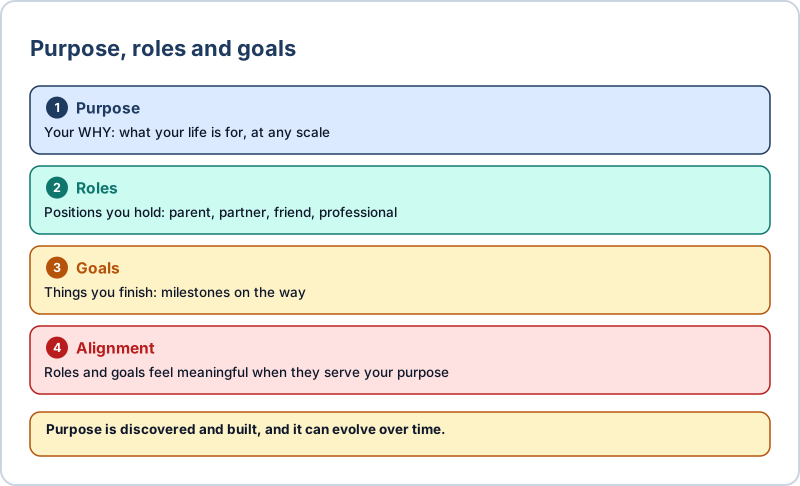
- Purpose is discovered and built, not handed down. You uncover clues from your own experience, then you shape them into a direction. It’s less like finding a hidden treasure and more like drawing a map from what you already know about yourself.
- Purpose can be lived at any scale. Raising kind children, making people feel welcome, building things that work, protecting the vulnerable, creating beauty: these are all purposes. None of them needs a stage or a title.
- Purpose evolves. The way you express it at 25 may look different at 45. The thread underneath often stays recognisable.
Purpose is not the same as a job or a goal
A goal is something you finish: run a marathon, change careers, pay off a card. A role is a position you hold: parent, manager, friend. Purpose is the why that runs through your goals and roles. Two people can hold the same job with completely different purposes. One teaches because she loves her subject; another teaches because he wants every child to feel capable.
When your goals and roles are connected to your purpose, effort feels meaningful. When they’re disconnected, even success can feel empty. That’s often the first sign that something needs redesigning.
Why it matters
People who can name what their life is for tend to find decisions easier, because they have a reference point. They also tend to recover from setbacks with more resolve, because the setback isn’t the whole story. You won’t need a perfect answer to feel that benefit; a working draft is enough.
Try this: the meaning snapshot
Think about the last few years and list:
- Three moments when you felt most alive or useful. What were you doing, and for whom?
- Three moments when you felt empty or restless, even if things looked fine from the outside.
Look at both lists and note any patterns. You’re not looking for answers yet, just clues. You’ll use them in the next lesson.
Workbook: complete Worksheet 1, “The Meaning Snapshot”, in your Personal Transformation workbook.