With your purpose, values and new beliefs in place, you’re ready for the most energising part of the course: designing the life of your dreams. A clear vision gives your daily choices a direction. Without one, it’s easy to stay busy without moving anywhere in particular.
What a good vision looks like
A useful life vision is:
- Rooted in your purpose and values, not in what looks impressive to others.
- Specific and sensory: you can picture an ordinary day in it.
- Whole-life: it covers more than work or money.
- Stretching but believable: it excites you and still feels possible.
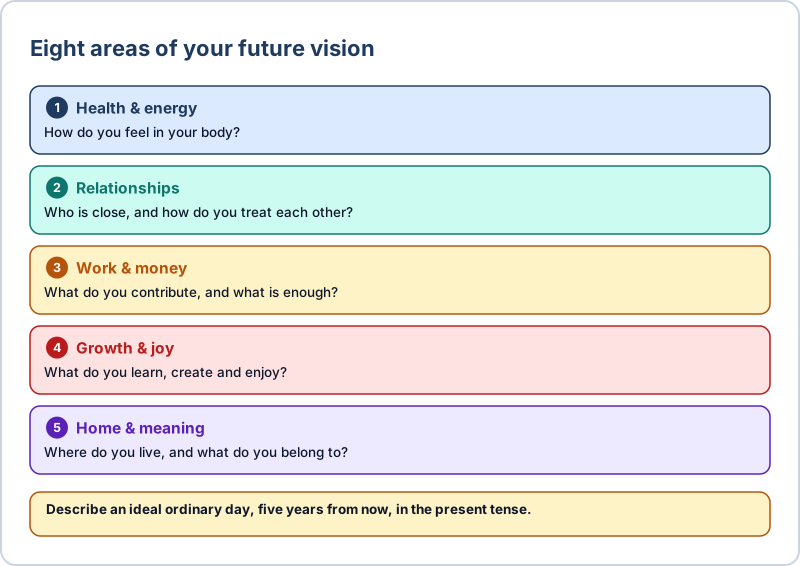
Eight areas of life
To make sure your vision covers your whole life, consider these areas:
- Health and energy
- Relationships and family
- Work and contribution
- Money and security
- Personal growth and learning
- Fun, rest and creativity
- Home and environment
- Community, spirit and meaning
You don’t need a grand plan for every area. Some areas might already be close to what you want. Others might need a lot of attention.
The ideal ordinary day
One of the most useful vision exercises is to describe an ideal ordinary day, five years from now. Not a holiday: an ordinary Tuesday. Write it in the present tense, from waking up to going to sleep:
- Where do you wake up? Who’s there?
- How do you feel in your body?
- What work do you do, and how does it serve your purpose?
- Who do you spend time with? How do you treat each other?
- What do you do for joy, rest and growth?
- How does the day reflect each of your core values?
Writing in the present tense (“I wake up early and walk to the river”) makes the vision easier to picture and easier to measure against.
True abundance
Abundance in this course means more than money. It means a life that feels rich in the things you value: time, connection, health, meaning and enough security to enjoy them. Your vision should describe your version of abundance, in line with your values, not someone else’s.
Try this: write your vision
Complete the Future Vision worksheet. Write a short vision statement for each of the eight areas, then write your ideal ordinary day. Read it through and check: Does this reflect my purpose? Does it honour my five core values? Adjust anything that doesn’t.
Workbook: complete Worksheet 10, “My Future Vision”, in your Personal Transformation workbook.