Once you know your purpose and values, a natural question follows: If I know what matters, why am I not already living that way? The honest answer is usually a mix of obstacles, some outside you and many inside. This lesson helps you name them.
Two kinds of obstacles
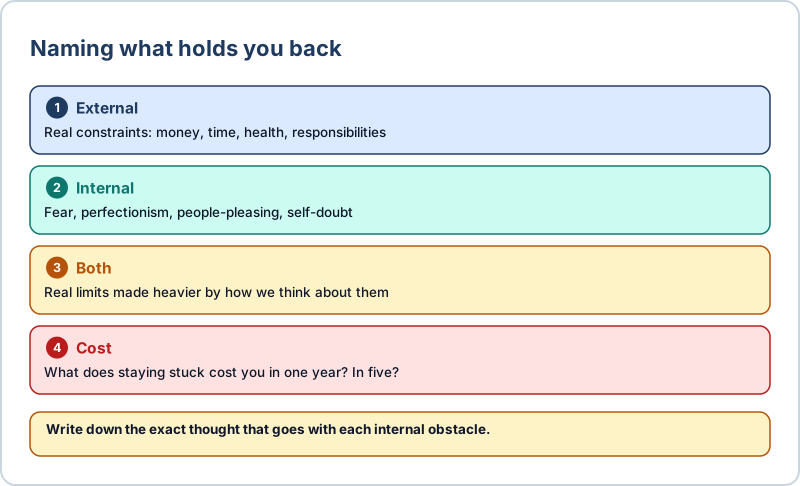
External obstacles are real constraints in your circumstances: limited money, health issues, caring responsibilities, location, time. They deserve respect and practical problem-solving. Pretending they don’t exist doesn’t help.
Internal obstacles live in your thinking and habits: fear of failure, fear of judgement, perfectionism, people-pleasing, procrastination, self-doubt and limiting beliefs. These are often the bigger barrier, because they shape how you respond to the external ones.
Many obstacles are a blend. “I don’t have time” may be partly true (a demanding job) and partly internal (difficulty saying no).
Common internal obstacles
- Fear of failure: If I try and it doesn’t work, it’ll prove I’m not good enough.
- Fear of judgement: What will people think if I change?
- Perfectionism: I’ll start when I can do it properly.
- People-pleasing: Other people’s needs always come first.
- Scarcity thinking: There isn’t enough time, money or opportunity for me.
- Comfort: This isn’t great, but it’s familiar.
You’ll probably recognise yourself in a few of these. Almost everyone does.
The cost of staying stuck
Obstacles persist partly because staying put feels safe. To weigh things fairly, make the cost of not changing visible. Ask yourself: If nothing changes, what will my life look like in one year? In five? Then ask: What is this obstacle costing me right now, in energy, relationships, health or joy?
Try this: the obstacle inventory
- Pick one area where your life is out of line with your values (from Lesson 2.3).
- List every obstacle you can think of that keeps you from changing it.
- Label each one E (external), I (internal) or B (both).
- For each internal obstacle, write the thought that usually goes with it, in your own words. For example: “I’m too old to start over.”
Keep this list. Those thoughts are the beliefs you’ll examine in the next lesson.
Workbook: complete Worksheet 7, “The Obstacle Inventory”, in your Personal Transformation workbook.