A limiting belief is a thought you accept as true that keeps you from acting in line with your purpose and values. It usually sounds like a fact: “I’m not a creative person.” “People like me don’t do that.” “If I put myself first, I’m selfish.” Because it sounds like a fact, you rarely question it.
Where limiting beliefs come from
Beliefs are learned. Most limiting beliefs formed for a reason, often to protect you. A child who was criticised for speaking up may learn “It’s safer to stay quiet.” That belief made sense at the time. As an adult, it may keep you from asking for what you need, sharing ideas at work or ending relationships that no longer fit.
Common sources include:
- Early messages from parents, teachers and peers.
- Painful experiences that you generalised: “I failed once, so I’m a failure.”
- Culture and community: unwritten rules about who gets to do what.
- Repetition: a thought rehearsed for years starts to feel like the truth.
How to spot them
Limiting beliefs tend to show up in a few recognisable forms:
- Absolutes: always, never, everyone, no one.
- Identity statements: I’m just not the kind of person who…
- Rules: I can’t… until… or I have to… or else…
- Predictions: It won’t work. They’ll laugh. I’ll regret it.
They also show up in your body. When you think about a change and feel a sudden tightening, sinking or urge to avoid it, there’s often a belief underneath.
Follow the thought down
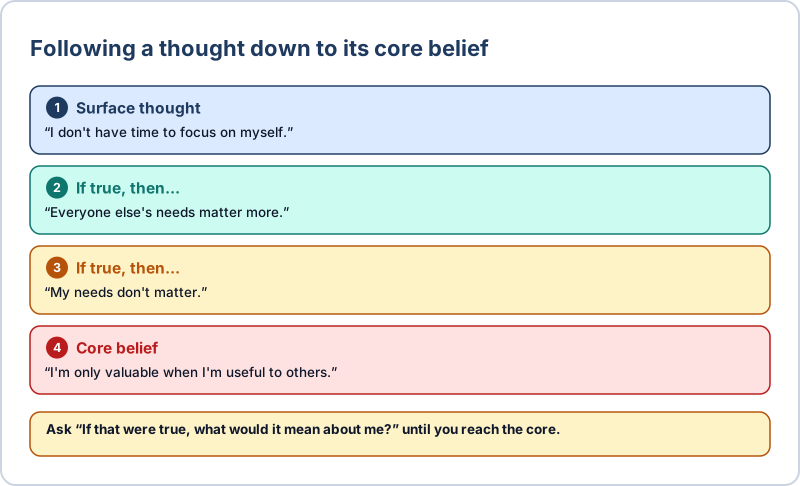
Take one of the internal-obstacle thoughts you wrote in Lesson 3.1 and ask, “If that were true, what would it mean about me?” Then ask the same question of your answer. Repeat three or four times. For example:
- I don’t have time to focus on myself. → If true, what would that mean?
- Everyone else’s needs matter more. → What would that mean?
- My needs don’t matter. → What would that mean?
- I’m only valuable when I’m useful to others.
The last answer is often the core belief: the one doing the real work. That’s the belief to change.
Try this: belief mapping
Choose two or three thoughts from your obstacle inventory. For each one, follow it down to its core belief. Note where you think it came from, and how it shows up in your life today. Be gentle with yourself. These beliefs once had a job. Now you get to decide whether they still deserve it.
Workbook: complete Worksheet 8, “Belief Mapping”, in your Personal Transformation workbook.