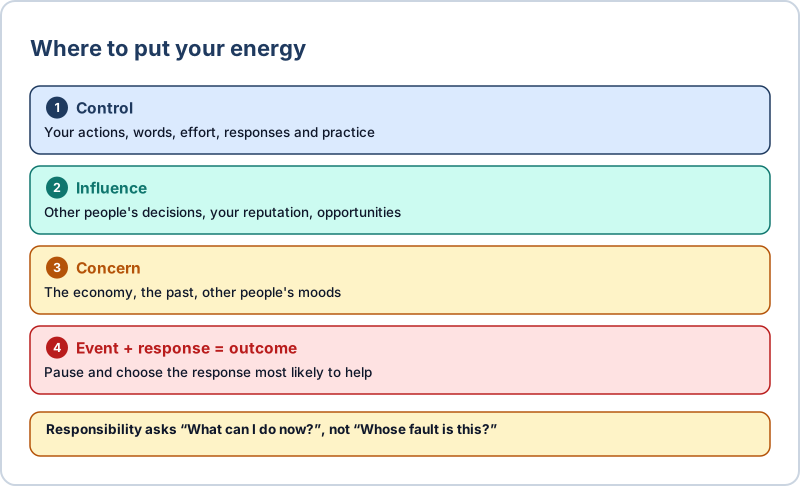
One principle shows up again and again in writing about success: take full responsibility for your choices, your responses and your results. This doesn’t mean everything is your fault. It means you focus your energy on the part you can influence.
Circle of control
Picture three circles:
- Control: your actions, your words, your effort, how you respond, what you practise.
- Influence: other people’s decisions, your manager’s view of you, your opportunities.
- Concern: the economy, the weather, other people’s moods, the past.
People who make steady progress spend most of their energy in the first circle and some in the second. Time spent worrying about the third rarely changes anything.
Responsibility is not blame
Blame looks backward and asks, “Whose fault is this?” Responsibility looks forward and asks, “What can I do now?” You can acknowledge real obstacles, unfairness and bad luck, and still ask what your next move is. That question gives you back some power.
Watch your language
Notice phrases that hand your power away:
- “I don’t have time” → “I haven’t made it a priority yet.”
- “They make me so angry” → “I get angry when they do that; how do I want to respond?”
- “I can’t” → “I don’t know how yet” or “I’m choosing not to.”
This isn’t about pretending; it’s about telling the truth in a way that keeps options open.
Own your responses
You can’t always choose what happens, but you can usually choose a response. A useful pause: event + response = outcome. When something goes wrong, take a breath and ask, “Given what happened, what response gives me the best chance of the outcome I want?”
Try this: the responsibility audit
Pick one area where you’re unhappy with your results. List the factors involved and sort them into control, influence and concern. Then circle one thing in your control and decide on one action you’ll take this week.
Workbook: complete Worksheet 2, “Responsibility Audit”, in your Success Principles workbook.