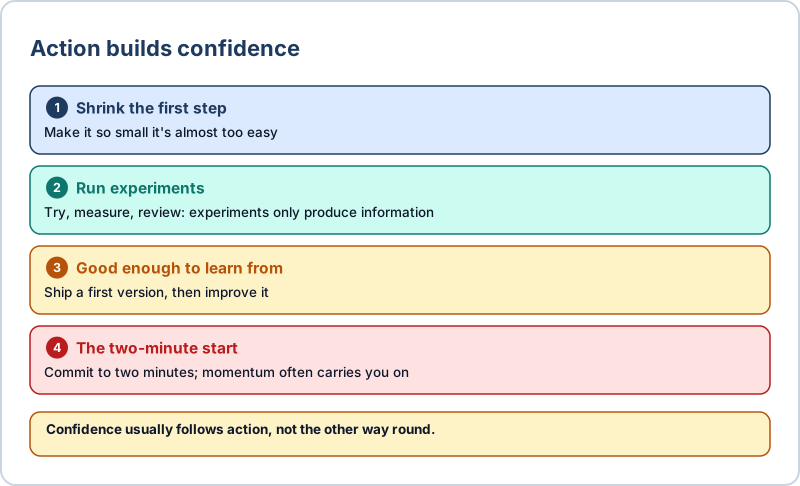
Many people wait to feel confident before they act. But confidence usually comes after action, not before it. You become confident at public speaking by speaking, not by waiting until the fear disappears.
Why we hesitate
Common reasons for not starting include fear of failure, fear of judgement, perfectionism and not knowing the first step. These feelings are normal. The aim is not to get rid of them but to act anyway, in small enough steps that the fear is manageable.
Make the first step tiny
Big goals feel overwhelming. Shrink the first step until it’s almost too easy:
- “Write a book” → “Write for 10 minutes today.”
- “Find a new job” → “Update the first section of my CV.”
- “Start a side business” → “Write down three possible offers.”
Starting creates momentum, and momentum makes the next step easier.
Treat actions as experiments
Calling something an experiment lowers the stakes. “I’ll try posting one article a week for a month and see what I learn.” Experiments can’t fail; they only produce information. Decide in advance what you’ll measure and when you’ll review.
Done is better than perfect
Perfectionism often hides as “high standards”, but it can stop you from shipping anything. Aim for good enough to learn from, then improve. A first draft, a first sale or a first conversation teaches you more than months of planning.
The two-minute rule
If a task takes less than two minutes, do it now. If a bigger task feels hard to start, commit to just two minutes of it. Often you’ll keep going.
Try this: start today
Pick the task you’ve been avoiding that matters most for your main aim. Shrink it to a first step you can do in 10 minutes or less. Do it today. Afterwards, write down how you felt before and after.
Workbook: complete Worksheet 10, “Start Today”, in your Success Principles workbook.