Every path to success is a chain of decisions: which opportunity to take, what to drop, when to persist and when to change course. You’ll rarely have perfect information. Good decision-makers aren’t always right; they use a sound process and learn from the results.
Separate decision quality from outcome
A good decision can have a bad outcome because of luck, and a poor decision can work out. Judge your decisions by the process: did you consider the options, the information available and your priorities? Over time, a good process tends to produce better results.
Reversible and irreversible decisions
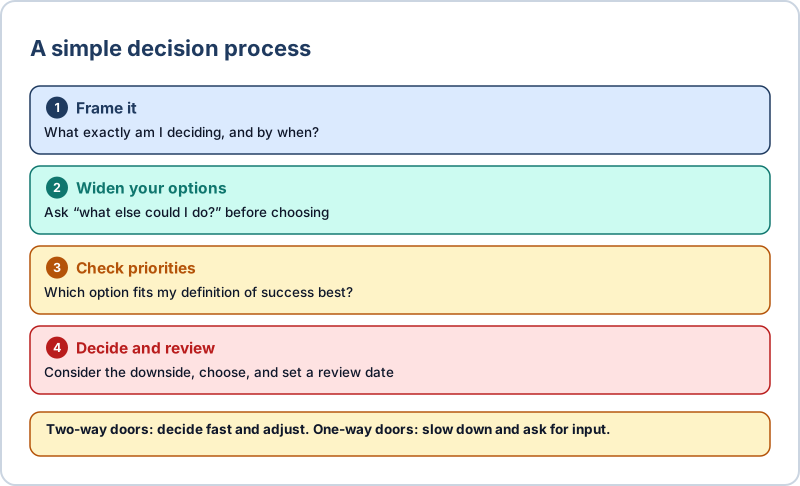
- Two-way doors (easy to reverse): decide quickly, try it and adjust. Most daily decisions are like this.
- One-way doors (hard to reverse): slow down, gather information and ask for input.
Many people treat small, reversible decisions as huge and agonise over them. Matching your effort to the stakes saves time and energy.
A simple decision process
- Frame it. What exactly am I deciding, and by when?
- Widen your options. Don’t settle for “this or that”. Ask: “What else could I do?”
- Check against your priorities. Which option best fits your definition of success and your main aim?
- Consider the downside. What’s the worst realistic outcome, and could you live with it?
- Decide and set a review point. “I’ll try this for a month, then review.”
Helpful questions
- “What would I advise a friend to do?”
- “How will I feel about this in 10 days, 10 months and 10 years?”
- “What’s the cost of not deciding?”
Try this: practise on a real decision
Choose a decision you’ve been putting off. Label it a one-way or two-way door. Work through the five steps, write your decision and set a date to review how it’s going.
Workbook: complete Worksheet 5, “Decision Worksheet”, in your Success Principles workbook.